Regime Change – an Inside Job
We are living in interesting times. And not only at high speed, but with an uncertain outcome. In the past, events still unfolded more or less in the rhythm of beginning, middle, and end. At best, we had time to process what had happened and form a considered opinion. Today, something new opens up every single day: new revelations, new events with long-term consequences, and now yet another war that seems to be spiraling out of control.
The daily news has become so absurd that many people turn to more or less gifted mediums on social media, following tarot readers, tea leaves experts, or anyone who claims to read the signs of the times, hoping to find out when the current nightmare will finally end. A nightmare in which ordinary people—people like us—seem to matter very little. Or perhaps, let me put it differently from the start: a nightmare in which we ourselves have lost our sense of direction and, in some ways, seem to have become indifferent to ourselves.
Is our greatest crisis really that authorities are failing, or that we never truly chose ourselves?
Many people experience this moment as a landscape of extremes. The center seems almost impossible to occupy without immediately being attacked from the left or the right. State institutions and their representatives are either ridiculed and despised or worshipped to the point of surrender of self. Sometimes both at the same time. When things no longer seem to move forward—or backward—in one’s own country, people often look elsewhere and project their hopes onto a distant savior who promises to tear everything down. And somehow, the destruction appears preferable to the stagnation people feel trapped in.
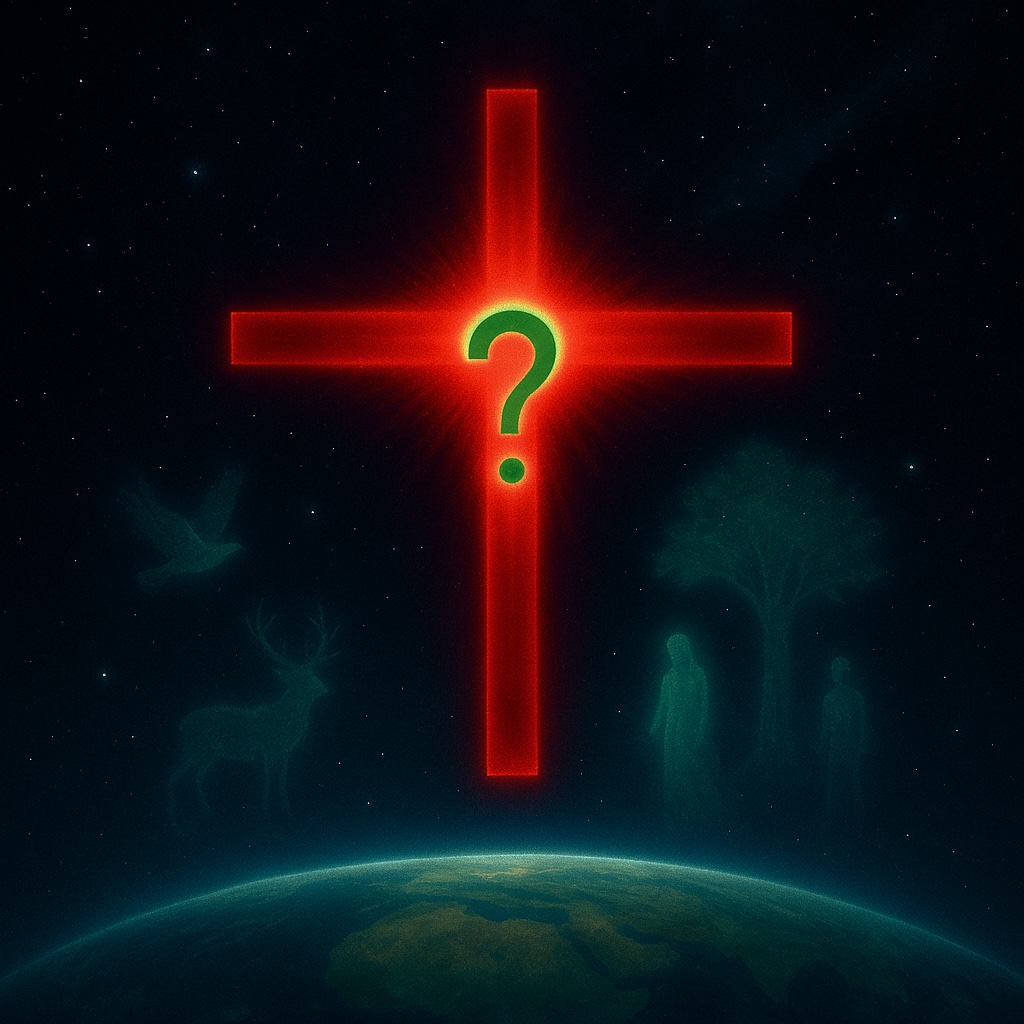
Religion, too, seems to be losing its promise of redemption. Increasing numbers of people are abandoning faith, at least outwardly. Religious institutions and their representatives are either tiredly dismissed or fiercely defended, as we are currently witnessing. When people can no longer be persuaded to support war through ordinary arguments, the so-called sacred texts are brought forward, and suddenly the “holy war” reappears. And remarkably, that still seems to work.
The German language has found remarkably fitting names for two of the great protagonists of this era: Father State and Mother Church (Vater Staat und Mutter Kirche). For centuries, these institutions have played the role of parents—setting rules, defining morality, and promising protection. Yet this parental substitute is now beginning to dissolve, and it refuses to acknowledge it. Control instead of relationship. And we, the children, must grow up—yet we resist this as well. Rebellion or illusion instead of participation and co-creation.
But this story began much earlier.
Let us look back to the year 1534. This was the time when Martin Luther published the complete German translation of the Bible. Around the same time, complete Bible translations also appeared in other European languages, including English and French. Access to sacred texts in one’s own language was becoming a continent-wide phenomenon.
The printing press, invented decades earlier by Johannes Gutenberg, made it possible for this and many other writings to spread. Knowledge began to circulate—slowly at first, since literacy itself was still rare—but the process had begun.
It marked the beginning of an information revolution, a decentralization of knowledge and authority, and the beginning of the Reformation. Earlier reformers had already questioned the authority of the Church. But with the printing press, Luther’s challenge spread across Europe.
People gained direct access to sacred texts. The authority and interpretive monopoly of the Church began to weaken, and with it emerged something new: individual conscience and a growing diversity of interpretations. Contradictions became visible, and not everyone was willing—or able—to live with this new ambiguity. Religious renewal soon turned into division and religious wars.
Now let us turn the clock forward to 1776, when the United States was founded with the signing of the Declaration of Independence. Thirteen British colonies turned their backs on the Crown and initiated their political self-determination.
Shortly afterward, the French Revolution shook the political order of Europe. The sacred authority of kings was challenged, civil rights emerged, power was redistributed—and above all, decentralized. Once again, the same pattern appeared: a great step toward liberty, equality, and fraternity, followed by a phase of radicalization and violence as the new order struggled to stabilize.
Both events carried light and shadow within them. They expanded human possibilities, yet they also confronted humanity with new tests of maturity.
Today we are once again living in a time when authority and knowledge are shifting. Information is globally accessible. Anyone can read, research, and publish. But access alone does not create maturity. It can also produce polarization, fanaticism, and echo chambers.
Many revolutions aimed to change the external order. Yet the inner patterns often remained unchanged. The American Revolution freed itself from the Crown, but social hierarchies persisted, simply in new forms. The French Revolution overthrew the monarchy, only to usher in a new phase of concentrated power and terror. Systems changed. The psychological structures behind them often did not.
What I have described here in simplified and selective terms corresponds to the cycle of Pluto in Aquarius—a cycle we’ve entered once again. Pluto takes about 248 years to orbit the Sun and symbolizes forces that bring hidden matters to the surface. These are the shadow themes people prefer not to confront—even though they appear everywhere.
As long as authority is either worshipped or fought in the outer world, the underlying pattern remains unchanged. The faces change, but the dynamic persists. Someone tells us what to think, what to believe, what is right and wrong, and how we are supposed to live. Someone claims to carry the responsibility we so willingly hand over – and to have a plan larger than ourselves.
It is striking that in recent years massive cases of child abuse have come to light within religious institutions as well as among political and social elites. Systematic abuse over many years. Abuse of the very life that was supposedly being protected. Abuse that was not prosecuted under criminal law but handled internally through transfers to new positions—or, in some cases, concealed entirely. And once again, the call is to move on and simply look forward.
The deeper question may not only be what these powers do.
It may be what it reveals about us that we continue to tolerate it.
What does it say about us that we allow these institutions to continue?
Real change may begin only when we recognize these patterns within ourselves. Regime change—as an inside job. The separation from Father State and Mother Church. The withdrawal of our projections.
Perhaps what we are witnessing is not merely a political crisis, but a crisis of maturity. The real question may not be which systems rise or fall—but what kind of authority we are willing to recognize in the future.
Another challenge is learning how to use freedom wisely. Not accepting every piece of information. Not amplifying every outrage. Not translating every tension immediately into enemies. Maturity begins where we learn to question, reflect, and differentiate—religiously, politically, and spiritually.
Inner authority does not mean always being right. It means being accountable for our own judgment and for the consequences that follow. Perhaps this is the next step in a development that began centuries ago—when human beings first began to read, think, and decide for themselves, yet often continued to surrender the power that came with those possibilities.
The crisis of institutions reflects a crisis of human maturity. The transformation required cannot be forced through violence. It requires three things: awareness, love, and personal responsibility. True change will not come from merely replacing external authorities, but from ending our inner dependence on them.
For centuries, Father State and Mother Church have enforced order, protection, and structure through control. They have shaped our sense of meaning, morality, and belonging through guilt, shame, sin, and threats of eternal suffering. And through these mechanisms, people can still be persuaded to sacrifice their lives in yet another senseless war in the name of something sacred.
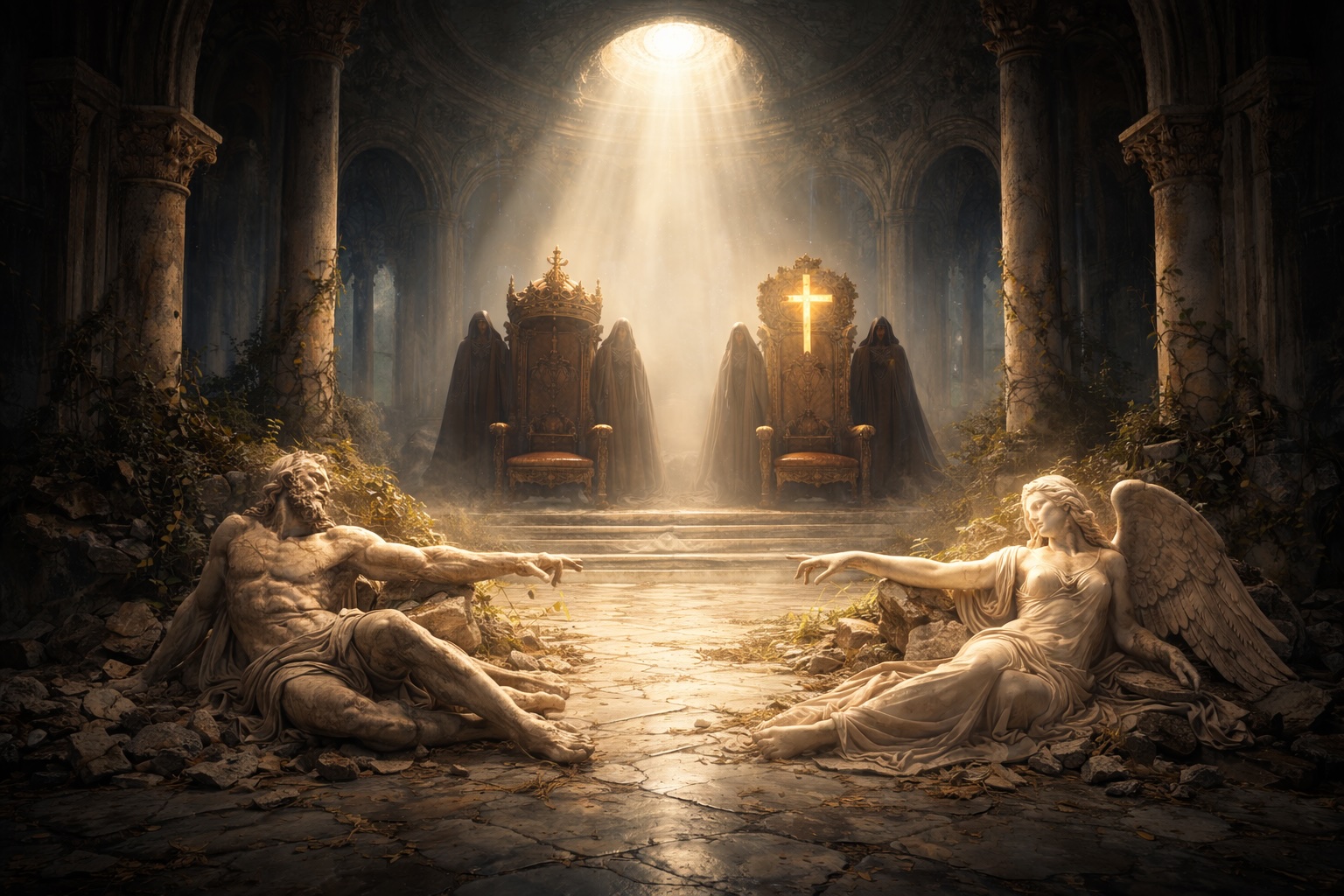
Our true spiritual parents—Mother Earth and Father Sky, the sacred feminine and the sacred masculine—were long ago displaced by human institutions driven by political motives and the desire for power and control. The sacred images of the inner mother and father were abused, and we with them. The inner divinity that once belonged to life itself was pushed aside, and we became dependent.
Yet true parents do not wish to keep their children small. They want them to grow, to mature, and one day to stand on their own feet—to become parents and role models for the generations that follow.
What we are witnessing now is the exposure of enormous abuses of power and the instrumentalization of sacred names and institutions. At the same time, many people feel a longing for peace, unity, and freedom. If we want to reach that place, we must first create unity within ourselves: an inner acceptance of light and shadow, the capacity for inner leadership based on values that support life rather than rules imposed by the ambitions of a few.
Pluto in Aquarius reflects this process. It brings hidden shadows to the surface and reveals what has long existed but remained unspoken. With Saturn and Neptune entering Aries at zero degrees, a new beginning has become possible—a chance to let go of these outdated parental substitutes and refuse to be bound any longer by guilt, shame, or imposed suffering.
We now have access to more information than ever before. We can follow in real time what is happening in the world. And the noise of those who cannot stop this process—those who claim to know better what is right and what is good—grows louder.
That is why a new topic appears every day. The density of events keeps increasing. We are bombarded with opinions and distortions, because this process can no longer be stopped. And although much of what we see on the world stage looks alarming, it may simply be the increasingly desperate attempt to preserve an old system of control over life itself.
When we consider that the scale and intensity of these reactions often reflect the emergence of something new, everything begins to appear in a different light.
Stay with yourself. Examine what you see and hear. And ask yourself, whenever something is presented to you: Does it make you more aware or more dependent? Does it strengthen your personal responsibility, or take it away from you? Does it bring more love and more unity into the world? For everything else, decide not to make yourself available, neither inwardly nor outwardly.
Are we ready to grow up?
© Peggy Vogt 2026

Leave A Comment